We read "Darkness Too Visible" and "Banned Books We Loved" together in class to study how readers can make meaning from lengthy and challenging texts and the craft moves authors use convey those ideas:
Here are links to those articles, as well as the ones available to you during our independent reading research periods that you can use as support in your argument essay or read to broaden your knowledge of the topic:
Age Rated Books: Right or Wrong? from BBC News
Man from Ministry Bans Potter from The Boston Globe
Darkness Too Visible from The Wall Street Journal
Has Young Adult Literature Gotten Too Dark? from Salon.com in response to Darkness Too Visible
Sherman Alexie, author of The Absolutely True Story of a Part Time Indian, responds to Darkness Too Visible
Ellen Hopkins' Banned Book Manifesto
Yes, teen fiction can be dark, but it shows teenagers they aren't alone, The Guardian's response to Darkness Too Visible
Megan Cox Gurdon's follow up to Darkness Too Visible: My "Reprehensible" Take on Teen Literature in the Wall Street Journal
Reading Improves Empathy from The Guardian
Sick Lit Books Aimed at Children by The Daily Mail
The Guardian's response to "Sick Lit" article from The Daily Mail
Perks of Being a Wallflower removed from the Chicago Tribune
Students ask school board to reconsider Perks of Being a Wallflower from The Chicago Tribune
Perks of Being a Wallflower reconsidered from the Chicago Tribune
A home base for Ms. Christensen's and Ms. DePalma's ELA classes. Check in here to find someone's blog, to access resources for class assignments, or to look for mentor texts.
Tuesday, October 15, 2013
Thursday, October 3, 2013
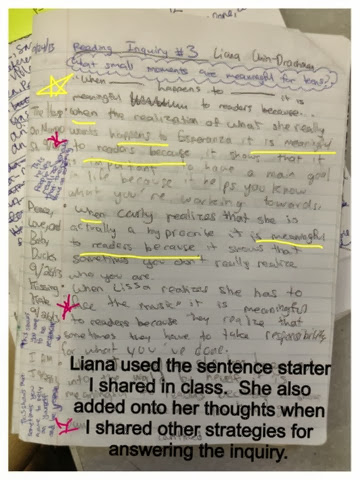
8th grade level annotations and amazing peer mentors!
As 8th grade readers, making an observation is only the first step into meaningful reading inquiries. To grow as thinkers, we must slow down and really go deep with what we noticed. Be sure to answer all parts of the inquiry question so that your notes can help build powerful ideas later.
For example, if you are looking for powerful small moments for teenagers in your text, you can:
1. Jot down the moments quickly as you read and leave space in between.
2. Go back and add your thoughts to them later, when you aren't immersed in your book.
Notice how these readers had a space on their inquiry page for not just what they observed, but what they were thinking about their observation. After observing, think about what you can do to make your reading inquiries more meaningful, especially since you will be sharing them with your new book groups! You always want to be at your book group meeting with some ideas formed and ready to share!
Monday, September 9, 2013
So you want to start a blog...
We will be creating an online community of readers, writers, and thinkers using blogs this year. It is an incredible opportunity to share your work with a REAL audience, rather than have your thoughts live just in your notebook. We will be doing plenty of work together on how to make this way of reading response work for you. For now, I want you to follow the directions below to set up your blog and then try out writing a reading response. Google requires that you are 13 years
old or have your parent/guardian's permission to have an account, so
please talk to your family about it when you give them the permission
slip.
By Friday, September 13th: Create your blog, turn in the permission slip and URL form
By Monday September 16th: Your first post is due, which will be a reading response based on a summer reading book. Please write your response based on what you know about reading response from last year. Use this as an opportunity to show me what you now about how to write a response to a book.
I am available during zero period Wednesday, Thursday, and Monday and am more than happy to set up a time to help you if you are having trouble. Please try not to wait until the last minute to set this up!
By Friday, September 13th: Create your blog, turn in the permission slip and URL form
By Monday September 16th: Your first post is due, which will be a reading response based on a summer reading book. Please write your response based on what you know about reading response from last year. Use this as an opportunity to show me what you now about how to write a response to a book.
I am available during zero period Wednesday, Thursday, and Monday and am more than happy to set up a time to help you if you are having trouble. Please try not to wait until the last minute to set this up!
How do I start a web log?
- Go to www.blogger.com and click on the “Create a Blog” button.
- Blogger is a part of Gmail and you will need a gmail account if you don’t already have one. If you already have a gmail email address, simply type it in. If you don’t, you can create one, using some combination of your first and last name if possible. Don’t forget your password! Write your address and password in a safe place. You can now also use this account for email, or use it just for your blogger account.
- Follow the directions to name your blog and create its URL. The name and URL do not necessarily have to match. (For example, my blog is called “Books Upon Books,” but that URL was already taken, so my URL is www.Room116ELA.blogspot.com .)
- Follow the directions to pick a template, and your blog is ready to go! Feel free to adjust the design if you want.
Privacy Settings and Options
- It is important to first adjust the privacy settings. Click on the blogger icon and then your blog’s name or just go to the “Design” link at the top right hand corner of your blog’s page. You will see a list come up on the side. Click on “basic” to get to the privacy settings and click on “edit.” Answer “no” to both questions so that it won’t come up in a search. Click on the “save changes” button.
- Go down to blog readers and click on “edit.” If you want to limit who is able to read your blog, add those email addresses here. If you are uncomfortable for any with having your blog open to everyone, you can choose who your readers will be and enter them in this section. Those users will have to go to your blog, request permission to see it and then be verified by you. My hope is that you are comfortable with sharing your work, but minimally I need to see it as well as your future book group.
- Click on “posts and comments.” Change it to “user with google account.”
Adding Gadgets
Click on “design” at the top
right hand corner again. Click on
“layout” on the left hand side.
Click on “add gadget”. When
you find one you want, click on the “+” sign. Be sure to save changes! As you customize your blogs, feel
free to utilize all the tools available to you on blogger. The following are
required:
Labels: Label each
post according to your focus (for example, “character change” or “theme”). You can also label posts according to
topic (“friendship” or “sports”) or title (“Hunger Games”).
Blogroll: you can
create a list of blogs you are reading on the sidebar. Everyone will be
responsible for commenting on their book group's blogs, so this is a great
place to put links to them for easier access. Each time an author posts something new, it automatically
moves that blog to the top of your list. You can add in the blogs once I add
them to our home base blog, www.room116ELA.blogspot.com.
List: this is an
online “Finished Book List.” As you finish a book, add it here.
Additional Guidelines
- This blog is a part of a school project. Therefore, all content on your blog must be related to your reading and writing life in some way. Please do not use this blog as an online journal.
- My expectation is that we are a community of readers and writers. I will be monitoring all blogs and trusting that your words that appear online will come from a place of respect for your fellow classmates as well with a tone that is appropriate for school.
Monday, April 15, 2013
Banned Books Research: Are Dark Young Adult Books Too Much for Teens?
These links are to support the upcoming Crank book club, but feel free to peruse if you are interested!
Darkness Too Visible by Megan Cox Gurdon (Wall Street Journal)
A twitter feed response to the article with links to many more #YAsaves
Banned Books Manifesto by Ellen Hopkins (The Huffington Post)
My Reprehensible Take on Teen Literature by Megan Cox Gurdon (Wall Street Journal) and the comments in response to the article
Reading Fiction "Improves Empathy," Study Finds by Alison Flood (UK's The Guardian)
The Sick-Lit Books Aimed At Children by Tanith Carey (UK's Daily Mail)
A twitter feed response to the article with links to many more #SickLit
A debate in response to the Daily Mail's article and The Guardian's response
An article from The Guardian in response to the Daily Mail's Article, "Sick Lit Books"
Tuesday, March 12, 2013
Regular People Think Critically About Texts, Too...FOR FUN!
Here is a link to an article from New York Magazine about the various interpretations of The Wizard of Oz. If you go to see the new movie, or just want to think about the original film or the book (one of my favorites from childhood), keep these ideas in mind and draw your own conclusions.
What other movies that you've seen can you come up with allegorical interpretations for?
Respond to the Wizard of Oz article in a future blog post or come up with your own!
What other movies that you've seen can you come up with allegorical interpretations for?
Respond to the Wizard of Oz article in a future blog post or come up with your own!
Monday, March 4, 2013
Strategies for Reading Romeo and Juliet: Class Notes
Strategies for Approaching a Difficult Text:
1. Know your resources: if you are struggling with a text, it's ok to consult a resource to help make meaning so that you can approach and discuss the text confidently. However, it is NEVER ok to substitute the resource for the text.
a. your book: the Folger edition is filled with resources: the best thing you can do is to read the scene summaries before you start reading and the glossary as you go and consult the character list if you are forgetting who is who. Also, feel free to make an "annotated" character list of your own to keep track of descriptions and actions
b. guides: book guides can help explain the plot, have character lists and often introduce you to major themes you can track. These can help supplement your understanding and can be used alongside of the original text. For Romeo and Juliet, consider No Fear Shakespeare--not as a substitute, but to help make meaning as you are reading.
c. film: movies can give an overall storyline and a visual of what is happening. Choose wisely how you approach film (before, during, after) and remember that it is an interpretation of the text. For Romeo and Juliet, think back to the film to help you imagine the scenes and what the characters were like.
2. Apply the close-reading skills you already know!
a. read more than once!
b. read collaboratively with a partner or group
c. remember to observe and infer: look for figurative language and poetic devices
d. make a character list to track important moments and actions of characters so that if you are getting names or plot points confused you can go back and check
e. use writing as a tool for thinking--what is your response to the actions you are seeing?
This kind of reading takes initiative, time, and effort, but you'll be amazed at the kind of reader you'll become!
3. "Monitor For Meaning": check to see if you are tracking with the text in order to decide if you are prepared for class discussion
a. REACT to the reading experience: how is it going? How are you creating meaning if you don't "get it" right away?
b. RETELL what happened in the plot: if you can, you're ready to go deeper. If you can't, consider what resources you should consult for help
c. RESPOND to the text: once you can follow the plot, it frees you up to think about the issues and complexities...we aren't reading for the plot, but to explore! We will be doing this kind of work in class!
1. Know your resources: if you are struggling with a text, it's ok to consult a resource to help make meaning so that you can approach and discuss the text confidently. However, it is NEVER ok to substitute the resource for the text.
a. your book: the Folger edition is filled with resources: the best thing you can do is to read the scene summaries before you start reading and the glossary as you go and consult the character list if you are forgetting who is who. Also, feel free to make an "annotated" character list of your own to keep track of descriptions and actions
b. guides: book guides can help explain the plot, have character lists and often introduce you to major themes you can track. These can help supplement your understanding and can be used alongside of the original text. For Romeo and Juliet, consider No Fear Shakespeare--not as a substitute, but to help make meaning as you are reading.
c. film: movies can give an overall storyline and a visual of what is happening. Choose wisely how you approach film (before, during, after) and remember that it is an interpretation of the text. For Romeo and Juliet, think back to the film to help you imagine the scenes and what the characters were like.
2. Apply the close-reading skills you already know!
a. read more than once!
b. read collaboratively with a partner or group
c. remember to observe and infer: look for figurative language and poetic devices
d. make a character list to track important moments and actions of characters so that if you are getting names or plot points confused you can go back and check
e. use writing as a tool for thinking--what is your response to the actions you are seeing?
This kind of reading takes initiative, time, and effort, but you'll be amazed at the kind of reader you'll become!
3. "Monitor For Meaning": check to see if you are tracking with the text in order to decide if you are prepared for class discussion
a. REACT to the reading experience: how is it going? How are you creating meaning if you don't "get it" right away?
b. RETELL what happened in the plot: if you can, you're ready to go deeper. If you can't, consider what resources you should consult for help
c. RESPOND to the text: once you can follow the plot, it frees you up to think about the issues and complexities...we aren't reading for the plot, but to explore! We will be doing this kind of work in class!
Sunday, January 13, 2013
New Monthly Non-Fiction Blog Post!
Starting now, you will be required to include at least one blog post per month that is in response to a NON-FICTION TEXT.
You are looking for an article that is at least 5-6 paragraphs long that presents an idea that you can analyze and think deeply about. Doing this assignment well requires finding an interesting article! Take the time to do that! Ask your family what kind of online news sources they read. Great resources for this response are:
The New York Times' Upfront Magazine (There are also copies in the classroom)
USA Today's Opinion Section
The Daily News' Opinion Section
The New York Times
You should use the same techniques for reading non-fiction that we have been working on in class. Think about the main ideas (the explicit, or, what the author wants you to know) and what the author wants you to feel or think (the implicit, subtle ideas) and how the author achieves this (what intentional craft moves did he/she use?) Your response will be structured like your non-fiction summaries, with an added third part - YOUR OWN OPINION. Each paragraph MUST be 5-7 sentences long. You must formally cite where your article came from (page R-3 in your agenda or noodle tools at ms51library.org) and provide a link if possible. Here is an overview of the structure:
Part 1: a summary that includes what the author wants you to know?
Part 2: an analysis of what the author wants you to feel and think and HOW the author achieved it (statistics, an appeal to emotion, loaded words, perspectives that are present or missing, etc.)
Part 3: your personal response to the article: formulate your own opinion on the ideas and issues presented in the text.
*******************************************************************
Here is a writing guide with questions to help you get started. This is a review from what we did during the first unit. Revisit your notes!
For Part 3 of a Nonfiction Blog Post, write your personal response, using these as sample questions:
*********************************************************************
Use the Non-fiction Blog Response Student Checklist in order to help you prepare for and write your posts!
You are looking for an article that is at least 5-6 paragraphs long that presents an idea that you can analyze and think deeply about. Doing this assignment well requires finding an interesting article! Take the time to do that! Ask your family what kind of online news sources they read. Great resources for this response are:
The New York Times' Upfront Magazine (There are also copies in the classroom)
USA Today's Opinion Section
The Daily News' Opinion Section
The New York Times
You should use the same techniques for reading non-fiction that we have been working on in class. Think about the main ideas (the explicit, or, what the author wants you to know) and what the author wants you to feel or think (the implicit, subtle ideas) and how the author achieves this (what intentional craft moves did he/she use?) Your response will be structured like your non-fiction summaries, with an added third part - YOUR OWN OPINION. Each paragraph MUST be 5-7 sentences long. You must formally cite where your article came from (page R-3 in your agenda or noodle tools at ms51library.org) and provide a link if possible. Here is an overview of the structure:
Part 1: a summary that includes what the author wants you to know?
Part 2: an analysis of what the author wants you to feel and think and HOW the author achieved it (statistics, an appeal to emotion, loaded words, perspectives that are present or missing, etc.)
Part 3: your personal response to the article: formulate your own opinion on the ideas and issues presented in the text.
*******************************************************************
Here is a writing guide with questions to help you get started. This is a review from what we did during the first unit. Revisit your notes!
For Part 1 of a Nonfiction Blog Post, answer these questions:
1. What is the overall main idea of the text (remember, you found this by looking at the main who+what of each paragraph)? What is the entire text mostly about? Include 3-4 details and try to directly quote at least one.
For Part 2 of a Nonfiction Blog Post, answer these questions:
1. What does the author want readers to think or feel?
2.. What are some craft moves the author uses to achieve this? How do they work? Try to include at least one direct quote here.
For Part 3 of a Nonfiction Blog Post, write your personal response, using these as sample questions:
1. What will you take away from it?
2. How has your thinking been shaped or changed, and why?
3. Do you have an opinion on the issue now?
3 4. Is there anything else you want to know?
Use the Non-fiction Blog Response Student Checklist in order to help you prepare for and write your posts!
Monday, December 3, 2012
Blog Post Due 12/5: Studying a Picture Book!
For this week's blog post, you will be writing about a picture book we read in class or one that you loved growing up (and have access to, so you can read it closely). Here is the reading work you will need to do:
- You will first read and interpret as "a reader": what does the author want you to know, feel, and think?
- You will then read as "a writer": what craft moves did the author use to get you to feel and think that way?
Once you are done studying the text, you can choose a claim/thesis that came out of your thinking work and use specific evidence to back it up. Here are some sample claims from Fox. Notice that they are ARGUMENTATIVE and require explanation. Once you choose your own claim, figure out how you can best support it with evidence, and how you can extend--meaning, what is this teaching you about humanity?
It is ok that Fox is manipulative because he is lonely.
Fox's manipulative behavior is selfish.
Dog is naive.
Dog is an example of the best kind of person and friend.
Even though Dog is a bit naive, he represents the best of humanity.
I can relate to Magpie because she has made mistakes and learned from them.
The theme of the book can be summed up in one of the lines: "I will be your missing eye and you will be my wings."
Magpie's journey home is representative of the work that good relationships take.
Tuesday, October 23, 2012
Critically Thinking in Video Research
It is important to look at video research with the same critical eyes that we used to analyze written texts. When you are watching these videos, consider our three questions:
1. What does the director/creator want me to KNOW?
2. What does the director/creator want me to FEEL?
3. What does the director/creator want me to THINK?
***and, of course, what "craft moves" are used to convey these things?
Here are some specific questions that will help you notice "craft moves" that can guide your viewing experience both now and whenever you are watching visual media.
1. A video that gives a bit of background on child soliders and talks about what UNICEF is doing to help former child soldiers heal: http://teachertube.com/viewVideo.php?video_id=232161 (almost 4 minutes)
2. A video that accompanies "Armed and Underaged" by Jeffrey Gettleman, one of the articles we read in class: http://vimeo.com/12563578 (3 minutes)
3. A video put out by Invisible Children that includes people of faith and in education and peace promotion asking for the world, and specifically the United States, to aid in the fight against Joseph Kony: http://vimeo.com/38406755 (3 minutes)
4. Invisible Children put out a video in 2006 when the topic of child soldiers was relatively new to much of the United States. How is this video similar to and different from the other videos we have watched? http://vimeo.com/3765452 (5 minutes)
Going Beyond the Our Classroom...for extra credit and for building those critical thinking muscles in your brain.
Follow the directions below that include watching a video and reading an article that responds to the video. Write a response that addresses the questions that follow. Minimally, write a paragraph on the video, a paragraph on the article and a concluding paragraph of your own thoughts. Each paragraph must be at least 5-7 sentences. Feel free to search for other video or textual resources and include links to them as well. This is worth 5-10 points onto a "major grade" assignment, depending on the quality of the post. Below explain in further detail the three parts of the extra credit assignment:
1. This is the full length "#Kony2012" video by Invisible Children, which went viral and started many conversations and controversies: http://vimeo.com/37119711 (29 minutes). Watch this video in light of what you have learned throughout this unit and be a critical thinker. Use these questions to guide your response.
3. After reading and watching so much about the issue of child soldiers, what are your thoughts, opinions and responses? Do you think there is value in considering lots of different sources?
1. What does the director/creator want me to KNOW?
2. What does the director/creator want me to FEEL?
3. What does the director/creator want me to THINK?
***and, of course, what "craft moves" are used to convey these things?
Here are some specific questions that will help you notice "craft moves" that can guide your viewing experience both now and whenever you are watching visual media.
Notice and write about how the creators use any or all of the following:
Images/imagery, in visual media, can be in the form of pictures or words
What images do you see?
What images do you hear described?
What feelings/thoughts do they elicit? How?
The words that are being spoken can add to the image you are seeing
The images are presented in a certain order; how are they organized?
Sounds are really important. What incidental sounds do you hear (from the real world) and what added sounds (music, sound effects, etc.)?
What is the tone of voice of the people who are speaking?
What are the elements of the video (interviews, clips, etc.?)
Who is represented? Whose perspective is missing? (Just like in written media!)
What emotional, opinion, or loaded words are used? (Also as in written media!)
1. A video that gives a bit of background on child soliders and talks about what UNICEF is doing to help former child soldiers heal: http://teachertube.com/viewVideo.php?video_id=232161 (almost 4 minutes)
2. A video that accompanies "Armed and Underaged" by Jeffrey Gettleman, one of the articles we read in class: http://vimeo.com/12563578 (3 minutes)
3. A video put out by Invisible Children that includes people of faith and in education and peace promotion asking for the world, and specifically the United States, to aid in the fight against Joseph Kony: http://vimeo.com/38406755 (3 minutes)
4. Invisible Children put out a video in 2006 when the topic of child soldiers was relatively new to much of the United States. How is this video similar to and different from the other videos we have watched? http://vimeo.com/3765452 (5 minutes)
Going Beyond the Our Classroom...for extra credit and for building those critical thinking muscles in your brain.
Follow the directions below that include watching a video and reading an article that responds to the video. Write a response that addresses the questions that follow. Minimally, write a paragraph on the video, a paragraph on the article and a concluding paragraph of your own thoughts. Each paragraph must be at least 5-7 sentences. Feel free to search for other video or textual resources and include links to them as well. This is worth 5-10 points onto a "major grade" assignment, depending on the quality of the post. Below explain in further detail the three parts of the extra credit assignment:
1. This is the full length "#Kony2012" video by Invisible Children, which went viral and started many conversations and controversies: http://vimeo.com/37119711 (29 minutes). Watch this video in light of what you have learned throughout this unit and be a critical thinker. Use these questions to guide your response.
- Is arresting Joseph Kony going to solve the problem of child soliders? How might this help?
- What other things, based on your research, might help solve the problem of child soliders?
- What techniques did the film makers use to appeal to your emotions (just like we studied in non fiction reading)? Are they effective? Does analyzing them critically impact what you think about the video?
- Is there anything you would add or take away from this video, based on our research?
3. After reading and watching so much about the issue of child soldiers, what are your thoughts, opinions and responses? Do you think there is value in considering lots of different sources?
Monday, October 22, 2012
All Star Mentors!
I was so impressed as I read through your blogs over the past few weeks! I am seeing so much improvement and so much passion for reading! Here are some posts that really blew me away. You should definitely check them out (no matter what class you're in) and leave them a comment for this week!
These "Am I Blue?" responses were so impressive and beautifully written:
Annabel (806)
Ruby (806-she also included an image I loved)
Sophie N. (809)
Sophie D. (809)
Adrian (809)
These posts about independent reading books were not only written well, but so thought provoking:
Sam (803)
Caitlin (803)
These posts about independent reading books were written in a way that generated thinking and comments:
Chase (806)
Venice (806)
These "Am I Blue?" responses were so impressive and beautifully written:
Annabel (806)
Ruby (806-she also included an image I loved)
Sophie N. (809)
Sophie D. (809)
Adrian (809)
These posts about independent reading books were not only written well, but so thought provoking:
Sam (803)
Caitlin (803)
These posts about independent reading books were written in a way that generated thinking and comments:
Chase (806)
Venice (806)
Friday, October 19, 2012
Studying Visual Media For Research Purposes: "Eye to Eye: Ishmael Beah"
Here is a link to the video we watched in class that will serve as our third research source for our argument essays. For Monday, you are to use your notes to write a full summary using the techniques we have covered in class.
Eye to Eye: Ishmael Beah (CBS with Katie Couric, June 5, 2007)
As a reminder:
First, ask yourself "what does the author (or director) want me to KNOW?" The facts (main ideas) presented will make up the first part of your summary. This is essentially a retell.
Then, you will begin to analyze what the author wants you to walk away feeling and thinking.
Ask yourself "what does the author (or director) want me to FEEL?" Add a sentence on to your summary that starts with "The director wants the viewer to feel_________ because___________."
Ask yourself "what does the author (or director) want me to walk away THINKING?" Here you are essentially naming the author's opinion. Add on a sentence to y our summary that starts with "The director wants the viewer to think ___________.
Monday, October 15, 2012
Finding A Focus...and using it to anchor your thoughts.
A. focus of your piece is also called a "thesis" or "claim." It is where you name what you are going to be writing about throughout the entire post.
An easy way to write out your focus if you struggle with this is to:
1. Choose a prompt question from the list hanging in the room or posted HERE.
2. Answer that question in a sentence or two (you will explain it in further detail later).
3. Then, turn the question part into a statement that leads into your answer. BOOM. You have a focus.
Watch the progression in this example:
1. "Who influences your protagonist? Is the impact positive or negative? Do you see similar things at work in the lives of your friends and peers? Explain.
2. Melvin has an incredibly positive influence on Vincent. I have noticed that when people my age have an adult to talk to honestly about life, they seem to feel more comfortable, peaceful and less stressed out.
3. When teenagers have someone to talk to honestly about their lives, it enables them to feel more confident as they face daily struggles like confusion and self doubt. Melvin is like a mentor to Vincent and his influence helps Vincent feel more confident in his identity.
Try this on your own right now for the post that is due tomorrow.
B. Use your focus to help anchor your thoughts for the rest of the post!
Now that you have this focus, use it to build the paragraphs that you will write. When I look at the above example, I know that I have to:
1. Introduce the story by naming the title and author AND who Melvin and Vincent are so the reader understands (adding context). I will do this before I name my focus, so that my reader will understand who Melvin and Vincent are when they read my focus. See how I changed it below:
The story "Am I Blue?" by Bruce Coville is about a teenage boy who is confused about his sexual identity---struggling internally through the issue as well as being bullied externally. Early on, a "fairy godfather" named Melvin appears and helps guide him through this stressful time of life. When teenagers have someone to talk to honestly about their lives, it enables them to feel more confident as they face daily struggles like confusion and self doubt. Melvin is like a mentor to Vincent and his influence helps Vincent feel more confident in his identity.
This focus/thesis/claim (those are all synonyms) can now go at the end of your introduction paragraph! The reader will know what to anticipate throughout your post.
2. Decide how you will "unpack" or elaborate your focus. What more do you need to say so that you fully communicate this idea?
When I look at my statement above, I see that I need to unpack two major things, which can become two paragraphs (you may decide you need more paragraphs or want to be more creative in your organizational style, which is fine):
First, I want to talk about how Melvin helps Vincent feel more confident. I can use text evidence and unpack it to support this.
Second, I want to talk about the idea of mentors for teenagers. I used to be a mentor and have had a mentor, so I have a lot to say.
Do you see how three paragraphs have just taken shape using my new, clear focus? Do this pre-writing work in your notebook before you start writing your post until it becomes second nature to you. If you practice this weekly, it will become second nature! Hang in there!
Take it one step further...look at YOUR "Am I Blue?" post. How might have this lesson have helped you with that post? Or, look at your other posts. How would this lesson strengthen them?
An easy way to write out your focus if you struggle with this is to:
1. Choose a prompt question from the list hanging in the room or posted HERE.
2. Answer that question in a sentence or two (you will explain it in further detail later).
3. Then, turn the question part into a statement that leads into your answer. BOOM. You have a focus.
Watch the progression in this example:
1. "Who influences your protagonist? Is the impact positive or negative? Do you see similar things at work in the lives of your friends and peers? Explain.
2. Melvin has an incredibly positive influence on Vincent. I have noticed that when people my age have an adult to talk to honestly about life, they seem to feel more comfortable, peaceful and less stressed out.
3. When teenagers have someone to talk to honestly about their lives, it enables them to feel more confident as they face daily struggles like confusion and self doubt. Melvin is like a mentor to Vincent and his influence helps Vincent feel more confident in his identity.
Try this on your own right now for the post that is due tomorrow.
B. Use your focus to help anchor your thoughts for the rest of the post!
Now that you have this focus, use it to build the paragraphs that you will write. When I look at the above example, I know that I have to:
1. Introduce the story by naming the title and author AND who Melvin and Vincent are so the reader understands (adding context). I will do this before I name my focus, so that my reader will understand who Melvin and Vincent are when they read my focus. See how I changed it below:
The story "Am I Blue?" by Bruce Coville is about a teenage boy who is confused about his sexual identity---struggling internally through the issue as well as being bullied externally. Early on, a "fairy godfather" named Melvin appears and helps guide him through this stressful time of life. When teenagers have someone to talk to honestly about their lives, it enables them to feel more confident as they face daily struggles like confusion and self doubt. Melvin is like a mentor to Vincent and his influence helps Vincent feel more confident in his identity.
This focus/thesis/claim (those are all synonyms) can now go at the end of your introduction paragraph! The reader will know what to anticipate throughout your post.
2. Decide how you will "unpack" or elaborate your focus. What more do you need to say so that you fully communicate this idea?
When I look at my statement above, I see that I need to unpack two major things, which can become two paragraphs (you may decide you need more paragraphs or want to be more creative in your organizational style, which is fine):
First, I want to talk about how Melvin helps Vincent feel more confident. I can use text evidence and unpack it to support this.
Second, I want to talk about the idea of mentors for teenagers. I used to be a mentor and have had a mentor, so I have a lot to say.
Do you see how three paragraphs have just taken shape using my new, clear focus? Do this pre-writing work in your notebook before you start writing your post until it becomes second nature to you. If you practice this weekly, it will become second nature! Hang in there!
Take it one step further...look at YOUR "Am I Blue?" post. How might have this lesson have helped you with that post? Or, look at your other posts. How would this lesson strengthen them?
Tuesday, October 9, 2012
Sample Blog Prompts, as collected by 803, 806 & 809
Character/Protagonist Questions:
- Describe your protagonist. In what ways do you relate to him or her? Be specific and explain.
- Who influences your protagonist? Is the impact of that influence positive or negative? Do you see similar things at work in the lives of your friends and peers? Explain.
- Describe a character relationship that has evolved or changed over the course of the story. Do you think that all relationships change over time? Why? How? Or why not? Explain.
- What kinds of things are preventing your protagonist from getting to the resolution? Why? Do you think conflict has an impact on emotions? How?
- How did your protagonist change by the end of the story? Was it for better or worse? What does this teach you about character change in the lives of real people? Yourself?
Conflict/Resolution/Theme Questions:
- Describe both the internal and external conflicts in the story. Do you agree with how they are being handled? Explain. Can you relate?
- Why do you think the story resolved the way it did What theme did it reveal? Did you like the ending? What does it teach the reader about life?
- How would you rewrite the ending or a scene? Why? What would that change about the theme and what a reader would take away?
Zooming in On Details Questions:
- Describe/quote some imagery you found that feels symbolic. Unpack it in the context of the story and the real world. What is symbolized?
- Quote a line from the story that really spoke to you personally. Unpack it and describe why.
- What were unique craft moves the author used to get you thinking? Describe/quote them and explain how they worked. How did this author inspire you as a writer?
Wednesday, October 3, 2012
Creating Better Community Through the Comment.
Part of the reason why I love posting reading responses online rather than just having them live in your notebooks is because it enables us to easily share about our reading lives. I believe that by reading one another's work, great things will happen. For instance:
- You can get book recommendations
- You can get into conversations about books you have read, too, or topics that are interesting to you
- You will become a better writer because not only are you reading work, but you will begin to care more when you know that people are reading your work
So, in order to create a tighter knit reading and writing community, you are now required to create a "blog list" if you haven't already of the blogs that you want to keep up with regularly. You are required to thoughtfully comment on at least 2 blog posts from your class weekly. My hope is that you will get to know each other better as readers (and nonfiction writers) and that you will learn from one another. I will be checking these responses.
A good, thoughtful blog comment might:
- praise interesting ideas in the original post, specifically (don't just say "nice job")
- ask for clarification of any unclear parts of the original post
- add the responder's own thoughts to original ideas to build strength
- contradict or challenge (respectfully!) by explaining another aspect or asking a question to further dialogue
- contain connections (to the self, the world, another text, or another part of the same text) to deepen thinking about the post
Sample starters:
- When you said __________ I thought________
- I love the line ____________ because___________
- When you said ____________ it got me thinking about________
*** AND good, thoughtful blog responses always
- are respectful
- use standard vocabulary, spelling, and grammar (so that everyone can understand)
- show consideration of the original blogger's work and thought
Additionally, as a writer, you will want to begin crafting your blog posts with your audience in mind. Think about how you might invite people into the ideas you are writing about. For instance:
- how could a creative title draw people in?
- how can the use of questions invite people to comment?
- how can you craft your blog post so that it sounds less like a boring homework assignment and more like a conversation people are dying to join?
Tuesday, October 2, 2012
Blogging Update!
Everyone has been doing a great job working on their blogs so far this year.
Today I want to talk about a few small ways that you can make your blogs even stronger moving on and take a look at some of your classmates' blogs that exceeded standards the past few weeks!
1. To show a new paragraph, instead of trying to indent, just skip a line and keep all of your words aligned left. This just makes it easier on the eyes for the reader.
2. Create a title that is more clever than the name of your book! Include what you're writing about.
3. To add a picture, do an image search online, and then click so that only the image is on the webpage. Copy that URL. In the draft form of your blog, click on the picture icon and click "add from a URL" and paste the link. The picture will download. Add a caption below it before you post the picture if you need to give credit to where it came from.
4. To add a link to another source, have the URL copied. Then highlight the word or phrase that you want to link from and click on the "link" tab at the top of the post draft. Copy the URL.
5. Finished Book Lists: Be sure that you have added this gadget to your sidebar and that you update it weekly or bi-weekly.
6. Blog link lists: visit the link lists on the sidebar of this blog to find at least 4 other people who you want to read and comment on regularly. Then add those people to your blog list. Add this blog as well, so that you can have easy access to it if you ever need support!
7. EDIT! I couldn't believe how many people didn't capitalize or check their grammar! Please, y'all. Please.
For the time being, starting now, the minimum requirement for blog length is 3 Paragraphs. A sample structure might look like:
Paragraph 1: A lead, an introduction to the story (context), your focus
Paragraph 2: Unpack your focus with textual evidence and elaboration
Paragraph 3: Extension: connect your focus to the world around you, yourself or another text. Explain why this matters beyond the page.
Finally, let's take a look at some of the blogs that blew me away as I've been reading them! I call these ALL STAR MENTORS!! Use them not only to get your brain thinking, but as strong mentor texts to use as a guide as a writer!
Isaac and Milo in 806, Sarah and Carmen in 809 and Dula in 803 wrote great responses to their independent reading books! Read them to be inspired!
Today I want to talk about a few small ways that you can make your blogs even stronger moving on and take a look at some of your classmates' blogs that exceeded standards the past few weeks!
1. To show a new paragraph, instead of trying to indent, just skip a line and keep all of your words aligned left. This just makes it easier on the eyes for the reader.
2. Create a title that is more clever than the name of your book! Include what you're writing about.
3. To add a picture, do an image search online, and then click so that only the image is on the webpage. Copy that URL. In the draft form of your blog, click on the picture icon and click "add from a URL" and paste the link. The picture will download. Add a caption below it before you post the picture if you need to give credit to where it came from.
4. To add a link to another source, have the URL copied. Then highlight the word or phrase that you want to link from and click on the "link" tab at the top of the post draft. Copy the URL.
5. Finished Book Lists: Be sure that you have added this gadget to your sidebar and that you update it weekly or bi-weekly.
6. Blog link lists: visit the link lists on the sidebar of this blog to find at least 4 other people who you want to read and comment on regularly. Then add those people to your blog list. Add this blog as well, so that you can have easy access to it if you ever need support!
7. EDIT! I couldn't believe how many people didn't capitalize or check their grammar! Please, y'all. Please.
For the time being, starting now, the minimum requirement for blog length is 3 Paragraphs. A sample structure might look like:
Paragraph 1: A lead, an introduction to the story (context), your focus
Paragraph 2: Unpack your focus with textual evidence and elaboration
Paragraph 3: Extension: connect your focus to the world around you, yourself or another text. Explain why this matters beyond the page.
Finally, let's take a look at some of the blogs that blew me away as I've been reading them! I call these ALL STAR MENTORS!! Use them not only to get your brain thinking, but as strong mentor texts to use as a guide as a writer!
Isaac and Milo in 806, Sarah and Carmen in 809 and Dula in 803 wrote great responses to their independent reading books! Read them to be inspired!
Subscribe to:
Posts (Atom)