Showing posts with label poetry. Show all posts

Friday, March 24, 2017

Spoken Word Poetry

To continue our exploration of poetry, we want to immerse you in some spoken word performances. As you listen, think about how speaking a poem changes the experience for you as a reader/observer. What kinds of things do you notice? What do they leave you thinking about?  How might it change you as a writer? Is there a poem you've written that needs to be spoken out loud?

Over the course of a few days we will watch performances by single spoken word poets and teams of spoken word poets. Consider: What impact do single and multiple voices have in spoken word poetry?

And of course, which of these speaks to you as a human? If you could choose a poet to perform for your graduating class who would it be? If there was one you could listen to every day for inspiration who would it be? How do these poems intersect with our social justice lenses and conversations? How do they connect to each other?

Single Speaker

Thursday, January 19, 2012

Blog Post Assignment Due 1/25

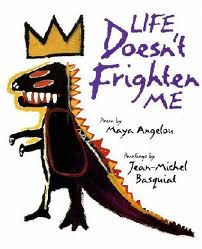
This week I want  you to continue with the thought process we have been working on all year (Observe+Infer, Interpret, Extend) and connect it to some of the visual arts work we have done in our poetry unit, including our study of Frida Kahlo's "Self Portrait on the Border" and the pairing of works by Jean-Michel Basquiat with Maya Angelou's "Life Doesn't Frighten Me."  Your job is to:


  •  Find a piece of visual art that you love and display it at the top of your post (use the button that looks like a picture when you write your post).  
  • Make observations about the work you chose.  What do you infer from them?  What do you think that the work is actually about based on them?
  • Turn these ideas into an organized blog post.  These steps are the same ones you should be following each week to meet standards anyway.  Remember: 
Paragraph 1: A lead, an introduction to the work, your theory
Paragraph 2: Evidence that supports your theory
Paragraph 3: Extension: how do you connect to this work? how does it connect to humanity? etc.

*as always, write more to exceed standards and check out mentors if you need help.
*don't forget that you are now commenting on at least TWO other posts per week!

Here are some online galleries that you can visit to find a piece of visual art that you love or find thought provoking.  Be sure to take your time to browse and explore so that you can find something you are excited about!

The Google Art Project takes you to amazing museums around the world. 
The Museum of Modern Art's (Manhattan) online collection
The Metropolitan Museum of Art's (Manhattan) online collection
The Brooklyn Museum's online collection

Extra credit: Along with  your post, write a poem in response to the piece of art.  It must incorporate at least three of the poetic devices that are on your sheet (that you are actively studying!) Name those devices in an introductory paragraph to your poem. 12 line minimum.


Monday, January 31, 2011

804, 812 and 813 are the best.

804, 812 and 813--

Lately, I have been so inspired by:


1. Your artwork in response to Dylan Thomas


2. Your poems in response to art that you found


3. The poems you found to respond to and the way you unpacked them.


Keep up the good work and amazing thinking!

Monday, January 10, 2011

A "meets standards" mentor blog post for your poetry post assignment. Or, This poem should change your life. Seriously.

Kindness by Naomi Shihab Nye (see, kiddos, I copied the poem AND the poet into the post!)

Before you know what kindness really is
you must lose things,
feel the future dissolve in a moment
like salt in a weakened broth.
What you held in your hand,
what you counted and carefully saved,
all this must go so you know
how desolate the landscape can be
between the regions of kindness.
How you ride and ride
thinking the bus will never stop,
the passengers eating maize and chicken
will stare out the window forever.

Before you learn the tender gravity of kindness,
you must travel where the Indian in a white poncho
lies dead by the side of the road.
You must see how this could be you,
how he too was someone
who journeyed through the night with plans
and the simple breath that kept him alive.

Before you know kindness as the deepest thing inside,
you must know sorrow as the other deepest thing.
You must wake up with sorrow.
You must speak to it till your voice
catches the thread of all sorrows
and you see the size of the cloth.

Then it is only kindness that makes sense anymore,
only kindness that ties your shoes
and sends you out into the day to mail letters and purchase bread,
only kindness that raises its head
from the crowd of the world to say
it is I you have been looking for,
and then goes with you every where
like a shadow or a friend.

(So I wanted to add a little introduction paragraph...I actually wrote this after I drafted my post)

I often hear the phrase "oh, she's so nice," or "he's too nice,"  or "be nice."  I hate this word because to me, it implies shallow, cold, "good" behaviors that someone could learn out of a book about manners.  I think that the word kindness carries so much more weight.  Naomi Shihab Nye's poem Before You Know Kindness I think really defines what the word kindness means--that it comes from a place of connecting with humanity, from a place of true empathy, from a place of brokenness.


(First, an OBSERVATION/INFERENCE paragraph--or two)
 One of the images that startles me every time I read this poem is that of everything dissolving. In the first stanza, she seems to be saying that the things people hold most dear in life can--and will--dissolve.  That we will experience loss in this world, no matter how hard we "counted and carefully saved." I think that line means that we cannot plan for everything and no matter how much we try to do things exactly right, there will be moments in life where our efforts will be of no use. 


She includes an image of seeing a man dead on the side of the road--that we must see him as a person before we can understand kindness; that we must truly break over his death.  In the following stanza, she uses a number of verbs to show that one must understand true sorrow in order to get to a place of true kindness: know it, wake up with it, speak to it. Those words mean that one must live in a place of hurt. The last stanza brings it together, because once someone understands suffering, then they know the secret of what really matters: "It is I you have been looking for," not the grade or image or money. 


(Then, an INTERPRETATION paragraph)
After reading this poem a number of times, I've come to the conclusion that the title of this poem implies that before we really know what kindness is, something else must happen--that life experience that causes someone to be kind. Someone can be taught to be nice: to share, to say please and thank you.  But kindness comes out of relating to the rest of the humans in the world who understand the most basic part of the human experience: suffering.


To live in a place of hurt the way Naomi Shihab Nye suggests sounds awful--like something to avoid.  But my old pastor used to talk quite a bit about how suffering is part of what makes us human.  Those who suffer connect to a thread that every other person who has ever hurt has felt. When one suffers, he or she realizes what actually matters and is able to let go of the shallow things they used to desire.  And, that when we understand suffering and join in with the throngs of humanity, we learn that we sought love and acceptance through the very wrong things. 


(Finally, an EXTENSION paragraph) 
There are so many ways to apply this and I think I will speak directly to my students.  I think it is important to think of the ways that you have been hurt. Gather up those feelings that you have survived through.  What was it that you wanted most while you were hurting? Now, look around you and try to discover who it is that might be suffering.  Ask yourself what true kindness looks like.  I think. I think that true kindness transcends 8th grade drama.  True kindness steps outside of social circles.  True kindness sees the humanity in one another and treats one another accordingly. And, when I glimpse moments of that among adolescents I truly have hope that maybe one day we will all see each other as people with hearts and stories and brokenness, rather than the other labels I watch students place on each other every day.  That is my hope. 

Friday, January 7, 2011

Next Blog Post Assignment due Thursday 1/13

I would like for you to respond to a poem of your choosing for your next post.  You may already have one that you love, or you might have to search on www.poets.org or www.poetryfoundation.org (you can search by category or by author...take the time to find one you like!). Your post must do the following things:

  • Include the poem itself and poet's name
  • Include at least 3 specific observations and your inferences about them
  • Include an interpretation of the entire poem based on what you observed and inferred
  • Extend your thoughts into connections to your life or the world
You may be creative in your formatting, or allot one paragraph for the 2nd, 3rd and 4th bullet points. I will have a mentor on my blog: www.akindoflibrary.blogspot.com.

Tuesday, January 4, 2011

Observe+Infer=Interpretation

Here are the pictures that accompanied our first poetry lesson, in which we decided that poetry is an art form and used the metaphor of painting to hone our skills.  Feel free to continue to observe/infer/interpret and even turn your response into a blog post (isn't writing FUN when you have something interesting to say!! share your thoughts! I promise it will make you feel really smart!).

Remember that this "equation" can be used in all kinds of genres and in all kinds of art.  You can, of course, still consider what the author/painter, etc. wants you to know, feel and think!

Self Portrait 1932, Frida Kahlo


The Persistence of Memory, Salvador Dali